



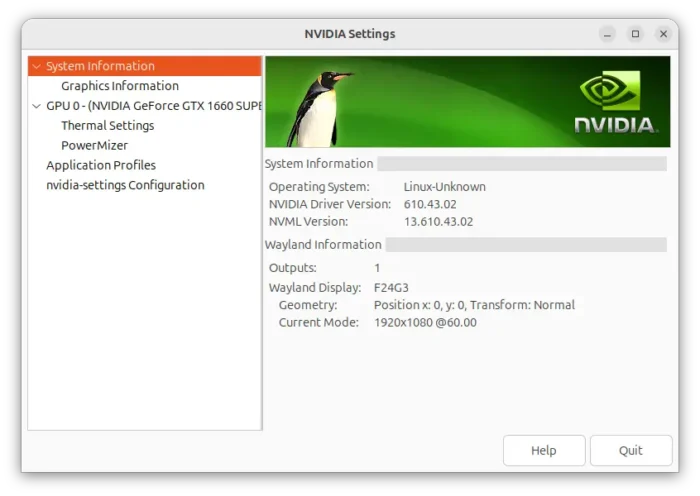
NVIDIA announced 610.43.02, the latest feature branch version driver for Linux, yesterday.
This is the first release in the new NVIDIA 610 driver branch, which introduced HDR output support for better high‑precision rendering support.
First, NVIDIA 610.43.02 added several new Vulkan device extensions support. They include VK_EXT_shader_long_vector extension that removes the traditional 4‑component limit, allowing GPU shaders to use “long vectors” beyond the usual 2/3/4‑component limit. It’s useful for scientific computing, machine learning kernels, and custom data packing, but it does not guarantee performance improvements.
It added VK_KHR_internally_synchronized_queues extension support, which can create queues that synchronize themselves internally, allowing multiple threads to call queue operations safely, and removing the requirement that the application must protect queue operations with its own mutexes.
It also added VK_NV_push_constant_bank extension support, that allows to specify a memory bank and offset for push constants, the small bank of values writable via the Vulkan API and accessible in GPU shaders.
For multi-GPU setup, the new driver added VK_KHR_device_group_creation support, allowing to enumerate groups of physical GPUs, then create single logical device from one group that represents multiple physical GPUs.
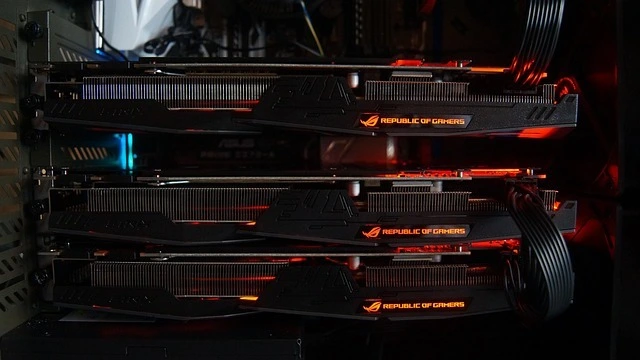
Image by Abigail Diseno from Pixabay
Besides new Vulkan extensions support, the new driver features direct HDR output support, by adding FP16 EGL framebuffer configurations on Wayland and DRM format modifiers support for multi-planar YCbCr formats.
Meaning Wayland compositors (e.g., GNOME Muter and KDE Kwin) can now import NVDEC output directly without CPU copies, which improves power efficiency, latency, as well as the performance for hybrid graphics (e.g., optimus laptops).
Besides HDR window composting, HDR video playback becomes possible, games can render in HDR, photo and video editors can high‑brightness highlights and other high‑precision rendering features.
NVIDIA 610.43.02 also added support for mmap on DMABUF file descriptors exported from discrete NVIDIA GPUs. Meaning that CPU can now read and write NVIDIA GPU‑allocated shared memory buffers, PipeWire screen sharing now works better, and it can now better interoperate with Intel/AMD integrated GPUs.
As well, it added the per-plane DRM color pipeline API (introduced in Kernel 6.19) support in the nvidia-drm kernel module. It allows Wayland compositors to offload color management (e.g. for HDR) to NVIDIA display hardware.
And, it also added ‘color_pipeline’ kernel module parameter to nvidia-drm, allowing to disable DRM color pipeline support in case your Linux Wayland compositors can not correctly handle color pipelines that contain non-bypassable colorops.

image from wikipedia.org
Other changes in this driver version include:
- Improved performance in Starfield.
- Fixed performance regression in Doom: The Dark Ages for the 590 driver.
- Removed support for using the NVIDIA X11 driver with Xinerama.
- Fix some mode timings (e.g., 1920×1080@75) not available in 580.65.06.
- Fix invalidated display modes in 580.105.08.
How to Install NVIDIA 610.43.02
The official release note as well as supported NVIDIA devices are available in its website via the link below:
It’s recommended to wait for your Linux Distribution build of this new driver package, though NVIDIA has its own repository that contains the most recent driver in .RPM/.DEB package formats for Debian, Fedora, Ubuntu, etc distributions.
And, I’ve written a step by step guide (Option 2) for Ubuntu users how to install the latest driver from that repository.
















The links are broken, there exists no 610 driver for ubuntu at that location.