Archives For Howtos

Linux Kernel 3.12.3

The latest Linux Kernel 3.12.3 has been released a few hours ago. If you’re using Kernel 3.12 series, this tutorial shows how to install or upgrade in Ubuntu 13.10, Ubuntu 13.04, Ubuntu 12.04, Linux Mint and their derivatives.

Linux kernel 3.12.3 is yet another big release that introduces numerous updated drivers, many architecture improvements (AMR, PowerPC, s390, parisc, ARM64, avr32), some fixes for the CIFS and EXT4 filesystems, as well as sound improvements.

See the changelog for details.

Install / Upgrade Kernel 3.12.3:

The DEB packages for Ubuntu and Debian users have been made into Ubuntu Kernel mainline page.

Press Ctrl+Alt+T on keyboard to open terminal. When it opens, run commands below one by one:

1. For 32 bit system, download the DEBs via:

wget http://kernel.ubuntu.com/~kernel-ppa/mainline/v3.12.3-trusty/linux-headers-3.12.3-031203-generic_3.12.3-031203.201312041453_i386.deb

wget http://kernel.ubuntu.com/~kernel-ppa/mainline/v3.12.3-trusty/linux-headers-3.12.3-031203_3.12.3-031203.201312041453_all.deb

wget http://kernel.ubuntu.com/~kernel-ppa/mainline/v3.12.3-trusty/linux-image-3.12.3-031203-generic_3.12.3-031203.201312041453_i386.deb

For 64 bit system, run:

wget http://kernel.ubuntu.com/~kernel-ppa/mainline/v3.12.3-trusty/linux-headers-3.12.3-031203-generic_3.12.3-031203.201312041453_amd64.deb

wget http://kernel.ubuntu.com/~kernel-ppa/mainline/v3.12.3-trusty/linux-headers-3.12.3-031203_3.12.3-031203.201312041453_all.deb

wget http://kernel.ubuntu.com/~kernel-ppa/mainline/v3.12.3-trusty/linux-image-3.12.3-031203-generic_3.12.3-031203.201312041453_amd64.deb

2. Install the DEBs:

sudo dpkg -i linux-headers-3.12.3-*.deb linux-image-3.12.3-*.deb

Restart your computer and done.

If your graphics card does not work properly with this kernel, you may re-configure or even re-install the video driver.

To revert back to previous kernel, reboot and go into Grub -> Advanced -> choose previous kernel. Then remove this kernel via:

sudo apt-get purge linux-headers-3.12.3-* linux-image-3.12.3-*

lightweight system monitoring tool


Want to monitor Ubuntu Server remotely with a graphical interface? Well, there are quite a few ways. Here I’ll you a lightweight tool called Monitorix.

Monitorix is an open source tool which allows to monitor server information through your web browser. It displays graphs with:

  • System load average and usage
  • Global kernel usage
  • Kernel usage per processor
  • Filesystem usage and I/O activity
  • eth0 network traffic and usage
  • System services demand
  • Network port traffic
  • Users using the system
  • Devices interrupt activity

Monitorix has a built-in HTTP server, it also works with Apache, Nginx, lighttpd, etc.

monitorix login screen

monitorix login screen

monitorix main window

monitorix main window

Install Monitorix:

On Ubuntu/Debian server, first install the dependencies:

sudo apt-get update

sudo apt-get install rrdtool perl libwww-perl libmailtools-perl libmime-lite-perl librrds-perl libdbi-perl libxml-simple-perl libhttp-server-simple-perl libconfig-general-perl

Download the DEB package (For the latest go to this page):

wget http://www.monitorix.org/monitorix_3.4.0-izzy1_all.deb

Install Monitorix:

sudo dpkg -i monitorix_3.4.0-izzy1_all.deb; sudo apt-get -f install

Start the service:

sudo service monitorix start

Finally, access remotely or locally by typing http://serverip:8080/monitorix in your web browser.

The config file is /etc/monitorix.conf. There you can change the port, deny or allow remote host, and something else.

virtual machine manager ppa


Virtual Machine Manager is a desktop interface for managing virtual machines through libvirt. It primarily targets KVM VMs, but also manages Xen and LXC (linux containers). It presents a summary view of running domains, their live performance & resource utilization statistics. Wizards enable the creation of new domains, and configuration & adjustment of a domain’s resource allocation & virtual hardware. An embedded VNC and SPICE client viewer presents a full graphical console to the guest domain.

virt-manager lists vms

virt manager guest cpu config

virtual manager guest console

Virtual Machine manager is available in Ubuntu universe repository, but it’s a little old. The latest version can be easily installed on Ubuntu 13.10 Saucy, Ubuntu 13.04 Raring, Ubuntu 12.10 Quantal, Ubuntu 12.04 Precise and Linux Mint via its PPA.

Press Ctrl+Alt+T on keyboard to open terminal. When it opens, run commands below one by one:

sudo add-apt-repository ppa:virt-manager/stable

sudo apt-get update

sudo apt-get install virt-manager

After that, start virtual machine manager from menu or Unity Dash.

mkvmerge gui ppa

MKVToolNix 6.6.0 was released recently with drag & drop support in the chapter editor. Here’s how to install mkvmerge from official repository in Ubuntu 14.04, Ubuntu 13.10, Ubuntu 13.04, Ubuntu 12.04, Linux Mint 13/14/15/16.

MKVToolNix is a set of tools to create, alter and inspect Matroska files under Linux, other Unices and Windows. They do for Matroska what the OGMtools do for the OGM format and then some. mkvmerge and mkvmerge GUI are part of the mkvtoolnix package, they can read a lot of different multimedia files and put their contents into Matroska files.

mkvtoolnix official repository

To get started, press Ctrl+Alt+T on keyboard to open terminal. When it opens, follow the steps below:

1. Run command to edit source file:

sudo gedit /etc/apt/sources.list

Add following two lines int the end. You may change saucy (for Ubuntu 13.10, Linux Mint 16) to raring (13.04, mint 15), quantal (12.10, mint 14), or precise (12.04, mint 13)

deb http://www.bunkus.org/ubuntu/saucy/ ./
deb-src http://www.bunkus.org/ubuntu/saucy/ ./

2. Download and install the key:

wget -O - http://www.bunkus.org/gpg-pub-moritzbunkus.txt | sudo apt-key add -

3. Install the GUI after checking for updates:

sudo apt-get update; sudo apt-get install mkvtoolnix mkvtoolnix-gui

This will always install the latest MKVToolNix on your system. For Ubuntu 14.04 Trusy, version 6.6.0 has been made into universe repository. Just search for and install it from Ubuntu Software Center.

simple batch audio video converter

Selene is an audio/video converter for converting files to OGG/OGV/MKV/MP4/WEBM/OPUS/AAC/FLAC/MP3/WAV formats. It aims to provide a simple GUI for converting files to popular formats along with powerful command-line options for automated/unattended encoding.

selene media converter

The converting process is quite easy, just select a batch of audio / video files, set the output format and click start.

Install Selene via PPA:

The converter is available in PPA for Ubuntu 14.04 Trusty, Ubuntu 13.10 Saucy, Ubuntu 13.04 Raring, Ubuntu 12.10 Quantal, Linux Mint and their derivatives.

To install it, press Ctrl+Alt+T on keyboard to open terminal. When it opens, run commands below one by one:

sudo apt-add-repository -y ppa:teejee2008/ppa

sudo apt-get update

sudo apt-get install selene

Once installed, start it from Menu or Unity Dash.
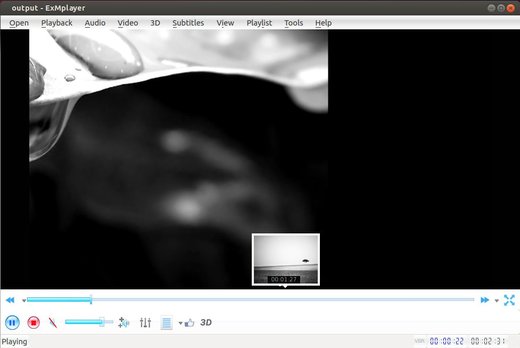
Fotoxx faster workflow


Fotoxx, the free and open source photo editing software recently released version 13.12 with UI revision for faster workflow when processing multiple photos.

Full changes in Fotoxx 13.12:

The user interface was revised for faster workflow when processing multiple photos:

  • An edit function can be started without closing a prior active edit function. The prior edit becomes the new base and an undo/redo position is added automatically.
  • You can step through a series of images with an open edit function. Apply the function to an image or pass over by pressing the [next] button.
  • Brightness and color functions can recall prior settings for faster application to other photos made under the same lighting conditions.

Other changes:

  • RAW files are now edited like other image files. Auto-copy to TIFF16 is no longer done. Edit as usual and save in the desired format (TIFF/PNG/JPEG8/16 bit color).
  • Add Text: new option: retrieve and edit metadata caption/comments.
  • Captions: new option: show metadata caption/comments above each image.
  • Move Collections is more flexible: any pathname segment can be replaced.
  • Some intermediate files now use ramdisk for a small performance gain.
  • Mashup: move layout images in 1-pixel steps with the keyboard arrow keys.
  • Mashup: internal speedups, especially when painting transparency.
  • New Slide Show transition type: double doors open from the middle.
  • Log file output was made always current, like a terminal session.

Bug Fixes:

  • Unsaved edits were lost if the [next] button was used beyond the last image file.
  • Curve nodes were lost when reloading saved complex edit curves.
  • Mashup: fix erratic overlay image corner drag behavior.

Install Fotoxx in Ubuntu:

The GetDeb repository contains the latest release for Ubuntu 13.10, Ubuntu 12.04 and their derivatives. To add the repository, run commands below in terminal one by one (Ctrl+Alt+T):

wget http://archive.getdeb.net/install_deb/getdeb-repository_0.1-1~getdeb1_all.deb

sudo dpkg -i getdeb-repository_0.1-1~getdeb1_all.deb

For Linux Mint there’s an option under “Software Sources -> Additional repositories” to enable Getdeb.

After that, install Fotoxx from Ubuntu Software Center after checking for updates. Or run commands below instead:

sudo apt-get update; sudo apt-get install fotoxx

Fotoxx 13.12 ubuntu 13.10

nautilus image tool


The developer of Touchpad indicator recently announced a new tool: Nautilus-Image-Tools. It’s an Nautilus extension allows to quickly manipulate your pictures through context menu.

The extension currently includes following functions:

  • black and white
  • blur
  • border, add white border
  • contour
  • convert to other file format,
  • enhance
  • flip
  • greyscale
  • negative
  • resize
  • rotate
  • shadow
  • vintage
  • watermark

Here are some screenshots:

nautilus image tool blur

nautilus image tool blur

nautilus image tool  with white border

nautilus image tool with white border

nautilus image tool  negative

nautilus image tool negative

nautilus image tool with shadow (png)

nautilus image tool with shadow (png)

Install Nautilus Image tool extension:

Press Ctrl+Alt+T on keyboard to open terminal. When it opens, run commands below to install it from developer’s ppa. Supports Ubuntu 13.10, Ubuntu 13.04, Ubuntu 12.10 and Ubuntu 12.04.

sudo add-apt-repository ppa:atareao/nautilus-extensions

sudo apt-get update

sudo apt-get install nautilus-image-tools

nautilus -q

NOTE that this extension is still in development stage. It sometimes freeze your browser and you need to restart it to fix the problem.

Once installed, right-click on an image file and see:

nautilus image tool context menu

How to Install Linux Mint 16 Petra From USB Stick

Last updated: December 1, 2013

Linux Mint 16 Petra usb

Linux Mint 16 has been released recently. It’s based on Ubuntu 13.10 Saucy. This tutorial shows beginners how to install Linux Mint 16 from USB stick.

All you need to do is download the ISO file, burn the image into USB, boot from usb and install Linux Mint.

1. Download Linux Mint 16 ISO file:

The Cinnamon and MATE editions are available in official download page

2. Burn Linux Mint 16 into USB

a. Insert 2GB+ USB and format it into FAT32 (DON’T check the “quick format” box).

b. Download Unetbootin, which allows you to create bootable Live USB drives for Ubuntu, Fedora, and other Linux distributions without burning a CD.

c. Open Unetbootin, choose the downloaded image file and click OK to start burning.

burn linux mint 16 into usb

d. Once done, in BIOS choose to boot with USB. You’ll see the screen below:

Linux Mint usb boot screen

3. Install Linux Mint 16 from USB:

In previous boot screen choose “Start Linux Mint”. When system boots up, click “Install Linux Mint” icon on Desktop to bring up install wizard and then you can follow this step by step guide to install Linux Mint.

Vuze 5.2 ubuntu 13.10

Vuze bittorrent client recently released version 5.2.0 with improvements, bug fixes and translation updates. It features torrent tagging, file prioritization, and more.

Vuze 5.2.0 change log:

  • Better organization of torrents files is possible with the introduction of color-coding for tags
  • Several improvements have been made to the torrent file experience overall.
  • users can also choose which file type to download, such as .avi, .mp4 and others.
  • The torrent client software now has a menu option in the notification area to dismiss all notifications.
  • Brazilian Portuguese, Basque and Spanish language updates have been implemented.
  • Persist column add/remove via header menu
  • Table structure change was losing a tag listener and subsequently failing to update correctly
  • Multiple concurrent torrent additions causing duplicate dialogs
  • Unloading a plugin was causing a second plugins images to be disposed
  • Search bar was truncating long URIs
  • Magnet plugin wasn’t handling URIs with ‘xt’ sections properly
  • Removed blocking call to get public IP address from initialization path
  • Respect ‘do not activate UI’ on download addition
  • Fixed end-game-mode looping bug
  • Lots of minor fixes detected by Coverity static code analysis tool
  • Improved performance of timer event handling
  • Fixed ‘upload only’ message support
  • Prevent a hanging UPnP device from blocking caller
  • Handle separators other than ‘-’ when parsing port ranges
  • Remove unnecessary retry on downloads that will most likely fail identically
  • Alert audio files weren’t playing when contained in folders with certain characters or symbols in name
  • Option to have multiple torrent-options screens on a single dialog as opposed to separate dialogs per torrent
  • Automatic application of tracker templates on a per-tag basis (to merge, replace and remove trackers)
  • Automatic tagging of downloads based on their trackers
  • Install Vuze 5.2.0:

    For Ubuntu 13.10 Saucy and Linux Mint 16 Petra, we can install Vuze 5.2.0 from GetDeb repository by running commands below one by one in terminal (Ctrl+Alt+T):

    sudo sh -c 'echo "deb http://archive.getdeb.net/ubuntu saucy-getdeb apps" >> /etc/apt/sources.list'
    
    wget -q -O- http://archive.getdeb.net/getdeb-archive.key | sudo apt-key add -
    
    sudo apt-get update
    
    sudo apt-get install vuze

    Or download and install the DEB package from here

    For other releases download the portable version from vuze homepage

    latest vuze 5.2 ubuntu 13.10

    remove keyboard indicator


    Since Ubuntu 13.10, there’s an indicator applet on top panel which allows to quickly switch between keyboard layouts for various languages.

    If you find that the keyboard indicator is useless, you can easily remove the applet from top panel by following the steps below:

    1. Open System Settings from Unity Launcher or from top-right corner shutdown menu. Then click on Text Entry

    System Settings Text Entry

    2. In the bottom of the window you’ll see “Show current input source in the menu bar” which is enabled by default. Uncheck the box and the indicator applet will disappear instantly.

    remove keyboard indicator

    That’s it. Enjoy!